
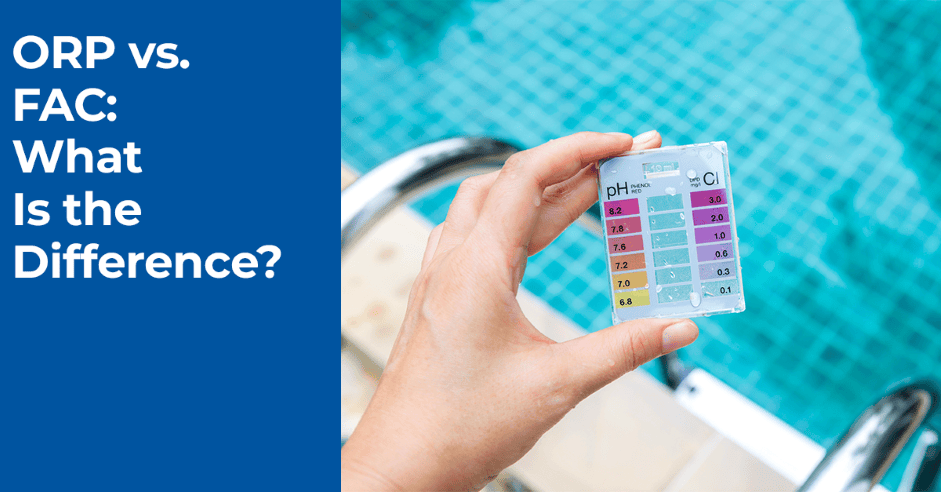
Free available chlorine (FAC) and oxidation-reduction potential (ORP) are commonly referenced in water chemistry reports, with each providing valuable information about sanitizer performance. FAC measures the concentration of chlorine available for disinfection, while ORP reflects the water’s overall oxidizing potential. Understanding what each measurement indicates helps pool professionals and commercial operators distinguish sanitizer concentration from its activity. Learn more about free available chlorine, oxidation-reduction potential and how to use both measurements to monitor water chemistry.
What Is FAC (Free Available Chlorine)?
Free available chlorine is the amount of chlorine available for disinfection. It primarily consists of two chemical species: hypochlorous acid (HOCl) and hypochlorite ion (OCl⁻).
FAC is typically reported in parts per million (ppm) or milligrams per liter (mg/L). This measurement differs from total chlorine, which includes both free available chlorine and combined chlorine. Combined chlorine forms when free chlorine reacts with contaminants and other compounds in the water.
What Is ORP (Oxidation-Reduction Potential)?
ORP measures the water’s ability to oxidize contaminants and is expressed in millivolts (mV), rather than ppm. An ORP sensor responds to the water’s overall oxidation-reduction conditions, so its reading can change as sanitizer activity and water chemistry fluctuate. Positive ORP values indicate oxidizing conditions, while negative values indicate reducing conditions.
ORP vs. FAC: Key Differences
While FAC measures the concentration of available chlorine in the water, ORP indicates its overall oxidizing potential. The two measurements differ in several key ways:
- Measurement:
- FAC reports the concentration of available chlorine, while ORP measures oxidation-reduction potential and reflects the water’s ability to oxidize contaminants.
- Monitoring:
- ORP controllers can track changes continuously, while a manual FAC test provides a measurement of the water at a specific point in time.
FAC and ORP are related, but their relationship is not fixed. Higher FAC levels can contribute to higher ORP readings, but a high FAC reading does not automatically indicate high ORP. As pH increases, the balance shifts from hypochlorous acid (HOCl), a more effective disinfectant, toward hypochlorite ion (OCl⁻). As a result, ORP readings can reflect changes in water chemistry even when FAC remains within the target range.
Using Both To Manage Sanitizer Levels
FAC should be used to verify chlorine levels and confirm compliance with applicable facility requirements and local regulations. ORP provides a continuous operating signal that helps operators monitor changes in the water’s oxidizing conditions.
For commerical pools, Rola-Chem’s Digital Controllers provide real-time monitoring to support sanitizer-feed decisions. Operators can use controller readings to investigate changes in water chemistry before adjusting chemical feed rates. Available models include pH/ORP monitoring options and dual configurations that display calculated free available chlorine alongside pH and ORP readings.
Probes should be cleaned and maintained according to manufacturer instructions to support reliable measurements. Depending on applicable local codes, manual sanitizer residual testing may still be required when an automated controller is installed.
Contact Rola-Chem to Dial in Your Water Chemistry
FAC measures the concentration of available chlorine, while ORP reflects the water’s oxidizing potential. Used together, these measurements provide a more complete picture of water chemistry and help operators make informed decisions about sanitizer management. Automated monitoring and dosing can further support consistent water chemistry by helping operators identify changes and adjust chemical feed rates as needed.
Rola-Chem’s Digital Controllers offer straightforward installation and intuitive operation to help simplify water chemistry management.
Contact Rola-Chem to discuss the right control approach for your facility.